Bro. Kirk is moving on to bigger and better things! We wish him best of luck in his new role as Principal of the School of Instruction, effective immediately. Just a reminder that SOI meets the first Monday of every month at 7:30p at the Frey center in Warminster. During the pandemic, meetings will be held virtually. Contact the Secretary for a link if you wish to attend.
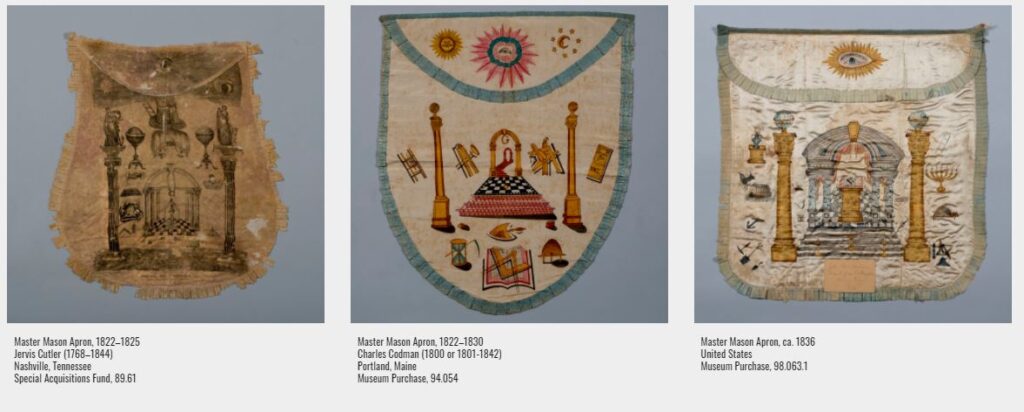
Aprons from the Scottish Rite Masonic Museum and Library
From “Rooted in Tradition,” an exhibition presented by the Scottish Rite Masonic Museum and Library:
Since Freemasonry’s early days in England, the apron has been a part of the group’s distinctive symbols and rituals. Aprons evoke the symbolic association of Freemasonry with working stonemasons, craftsmen who wore aprons to protect their clothing from wear and dust. Decorated aprons may have emerged as a way for non-working, or symbolic, Freemasons to distinguish themselves from working, also called operative, stonemasons and/or other artisans.
Visit the full exhibition online:
https://sites.google.com/view/rootedintradition/rooted-in-tradition
Lodge Update
On Friday, October 9th, we will also be hosting our first-stated meeting since the Coronavirus pandemic restrictions began. While we’re all very much looking forward to getting back into the lodge and returning to a sense of masonic normalcy, the safety of our members remains our top priority, and we are striving to conduct each meeting in the safest manner possible. To that effect, we have set up our lodge to ensure social distancing measures are observed and have protocol in place to ensure proper sanitization resources are available and utilized. Additionally, each meeting is limited to 25 attendees, with RSVPs required for those interested attending.
The mysterious ‘inverted tower’ steeped in Templar myth
Steeped in strange symbology, the breath-taking ‘inverted tower’, or initiation well, found at the heart of Sintra’s Quinta da Regaleira celebrates Portugal’s unique historical connection to the mysterious and enigmatic Knights Templar.
https://www.bbc.com/reel/video/p07r1cbm/the-mysterious-inverted-tower-steeped-in-templar-myth
BBC Reel. Video by Fernando Teixeira and Izabela Cardosa
An Abridged History of Doylestown Lodge
In 2024, an abridged history of Doylestown Lodge was presented to the Grand Lodge of Pennsylvania as follows:
Doylestown Masonic Lodge No. 245
55 E. State Street, Doylestown, PA 18901
PA 8th Masonic District
Established 1850
Prepared & abridged by:
Bro. Alfred Paschall, P.M., 1881
Bro. Richard T. Butler, P.M., 1994
Bro. John M. Dominic, P.M., 2016
Doylestown Lodge No 245 as it is known today is actually the second Masonic Lodge in the borough of Doylestown – the county seat of Bucks Country, Pennsylvania. It was a descendant of Benevolent Lodge No. 168 which was constituted in 1829. That Lodge met at “Temperance Hall” between Church and Broad Streets for eight years, but for reasons unknown, the Lodge failed and was vacated in 1837. Without Benevolent Lodge, the need for a local Masonic meeting place persisted as the next closest Lodge was in Bristol, an arduous 30-mile trek through darkness for members in a time before electricity. Thus, on August 27th, 1850, Doylestown Lodge No. 245 was created, and the first meeting was opened by its Charter Members at 7:00 pm on Monday, September 16th, 1850 (the Monday preceding the full moon) at Temperance Hall. The Lodge was founded by William Carr of Lodge No. 195, Pennsylvania; Stephen Brock, Abraham Morris, Josiah Rich, John McIntosh & John D. James of Lodge No. 168, Pennsylvania; John William Fry of Lodge No. 2, Pennsylvania; John S. Bryan, Lodge No. 115, and Pennsylvania; and Caleb E. Wright & Jonas Ott, Lodge No. 12, New Jersey – with Brother John William Fry elected to serve as the inaugural Worshipful Master.
Doylestown received its Warrant from the Grand Lodge of Pennsylvania on August 27th, 1850, and a project was formed to secure an official meeting hall as an alternative to Temperance Hall. By the end of 1850 there were 18 members and stated meetings were officially set to Friday nights. Doylestown Lodge officially purchased the current site at 55 East State Street on April 8th, 1857, originally dubbed “Beneficial Hall” for $2,545.00 which has been meeting at that location ever since January 1858. Membership grew rapidly during the Lodge’s formative years. By the 50th Anniversary, membership increased to 221 members. Members of the Lodge, averaging 30 years old, came from all walks of life: farmers, doctors, painters, lawyers and tinsmiths. Lodge records tracing back to 1900 also reflect that Doylestown Lodge prided itself on being an “industrious working organization.”
Over the next 174 years, the Lodge would grow and see many new faces and perform many projects assisting in the betterment and relief of our local Masonic community and beyond. Today, Doylestown Lodge continues its proud tradition of being an industrious working organization and the bedrock of York Rite activities across Bucks County, Pennsylvania. Currently, the Lodge has around 400 members and will celebrate its 175th Anniversary in 2025. When Doylestown Lodge was founded, the only other Masonic Body in Bucks County was in Bristol, Pennsylvania. Since 1850, Lodges were established at Newtown, Hatboro, Quakertown, Lansdale and Sellersville – all of which have drawn something from Doylestown, especially Hatboro and Newtown, as our members resigned almost in delegations in 1867 and 1868 to constitute those Lodges. In the Masonic growth that has since fostered throughout Bucks Country, Doylestown has a just claim to the work accomplished by these sister Lodges. Notably, Doylestown Lodge is also unique in that it has become home to the other York Rite Masonic groups within the county, including Doylestown Royal Arch Chapter No 270, Cryptic Council No 51, Mizpah Commandery No 96, and the Order of Eastern Star No 327.
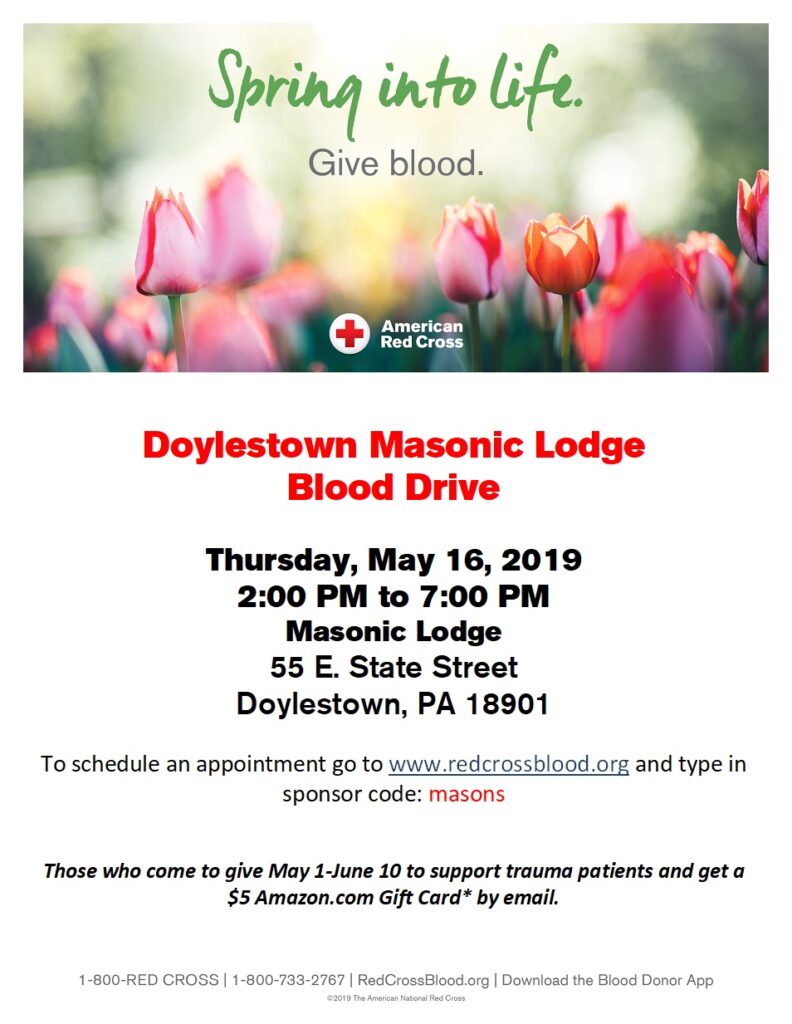
Charitable donations have been a hallmark of the Lodge in times of war and peace. Doylestown has contributed donations and relief from events such as the Great Chicago Fire in the 1800s, to donating Liberty Bonds in WWI and WWII, including numerous disaster relief initiatives, local scholarships and community events (notably the Travis Manion 9/11 Heroes Run), down to helping local families who need support over the holidays. Today, the Lodge currently contributes around $10,000 annually to charity, while many members also personally support the Shriners Hospital, Scottish Rite Children’s Dyslexia Centers, Masonic Retirement Homes and other Freemason-led charities through Doylestown’s appendant bodies. The Lodge also supports its local community by hosting Red Cross Blood Drives as well as participating in the Doylestown Memorial Day Parade – the nation’s oldest continuously running parade.
There have been many members who have contributed to the continually high standards of work which Doylestown Lodge prides itself on. Recently, many names stand out as pillars of Masonic strength and support, notably Bros. Ralph E. Wagner, Robert D. Fighera, Jr., and Grant L. Sergeant each of whom had spent their lifetimes training generations of new members and officers in the ways of the Craft. In the last 20 years, Doylestown also supported the mission of the Grand Lodge of Pennsylvania through the dedicated efforts of Bros. Carl L. Swope and Richard H. Bradbury, Sr., who served as District Deputy Grand Masters of the 8th Masonic District of which Doylestown is a member. Yet among all of the Brethren who came before, there are three original members to whom the Lodge is under deepest gratitude: Bros. John William Fry, William Carr, and Hiram Lukens. Bro. John W. Fry was the first Worshipful Master and during his lifetime of service was an ardent and devoted craftsman and an indefatigable worker until his passing in 1860. Bro. William Carr was the first Secretary and gave valuable service in that office until 1860. Bro. Hiram Lukens was Lodge Secretary for over thirty-nine years. He lived Masonry. The Lodge was his family, the members were his nearest associates. He died November 20th, 1897, and was buried in Doylestown Cemetery with the ceremonies of Masonry and in the presence of a great number of the Brethren. The work of these three brethren performed for love of the Craft is inestimable if not incalculable in the beneficent influences exerted upon and for the Lodge.
Today, we echo the same sentiments of these esteemed Brethren who founded Doylestown Lodge No 245 nearly 175 years ago. What the Lodge has been we are aware, but what it may become God only knows. Yet we persist in our Fraternal duties with optimism knowing that if we are united, our Fraternity must flourish.
Cardinal Virtues – Fortitude
In Freemasonry, the cardinal virtue of Fortitude is defined as the noble and steady purpose of the mind whereby we are enabled to undergo any pain, peril or danger, when prudentially deemed expedient. The word is borrowed from Old French, from Latin fortitūdō (“bravery, strength”), from fortis (“brave, strong”). In the traditional sense, Fortitude embodies the quality of character which gives a person strength to withstand temptation and to bear their suffering in silence when all other remedies fail.
The Craft in photos
Sarah Richards, a photographer from Norwich, stitched together up to 45 photos to capture the grandeur of the United Grand Lodge of England in a single image known as a vertical panorama.
Grand Master Whiskey
First there was Grand Dad, now there’s Grand Master. Please see attached form to order your own bottle of Grand Master whiskey. The proceeds go to charity… so win/win!

2020 Scholarships Now Available
The Doylestown Masonic Lodge annually awards scholarships of $500 to graduating high school seniors from local schools who have been involved in community activities including volunteer service and have demonstrated a dedication to their high school academic experience.
About the Master’s Medal 2020
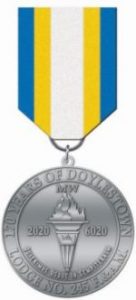
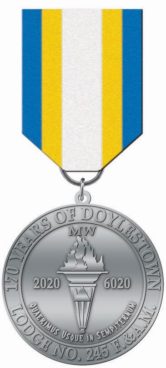
170 Years of Doylestown Lodge. Embossed in the center is a flaming torch, figuratively representing energy, transformation, enlightenment, and problem-solving. Embossed on the handle is a triangle (or Delta) indicative of the manual carriage of light by humankind and the transformation it thus creates. The Latin phrase “Quaerimus Usque In Sempiternum” below the torch means “Forever Seeking” while the blue, white, and yellow striped ribbon represents the ongoing journey to enlightenment as illuminated by the Sun and Moon.
2020 Bro. Matheu C. Wilson, W.M.
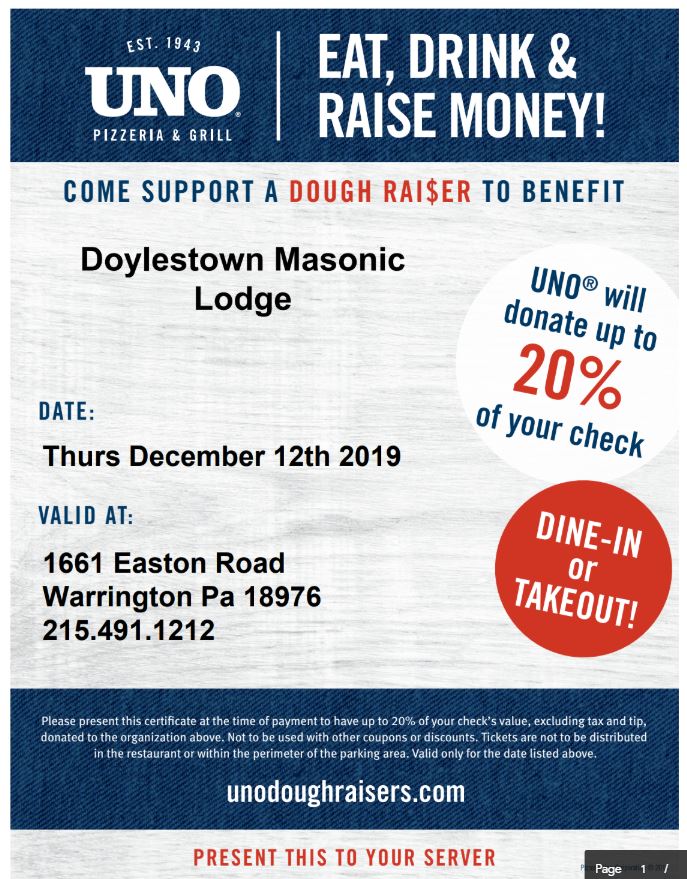
UNO Dough Rai$er
Join us Thursday December 12th for an UNO Fundraiser at 611 and Almshouse location. Up to 20% of the proceeds will come back to the lodge to purchase holiday poinsettia plants for our widows (which members will deliver in person in December). If you cannot go, we ask that you please pass the ticket onto someone who can – anyone can submit the enclosed ticket with their meal. UNO is open from 11am until 9pm, and both dine-in and take-out orders count towards our total. Thank you for your support.
It Belongs in a Museum
Brother Hunnicutt came across a rare find – a trowel set from the lodge’s own 75th anniversary back in 1925. He was able to rescue the set and it is on its way home.
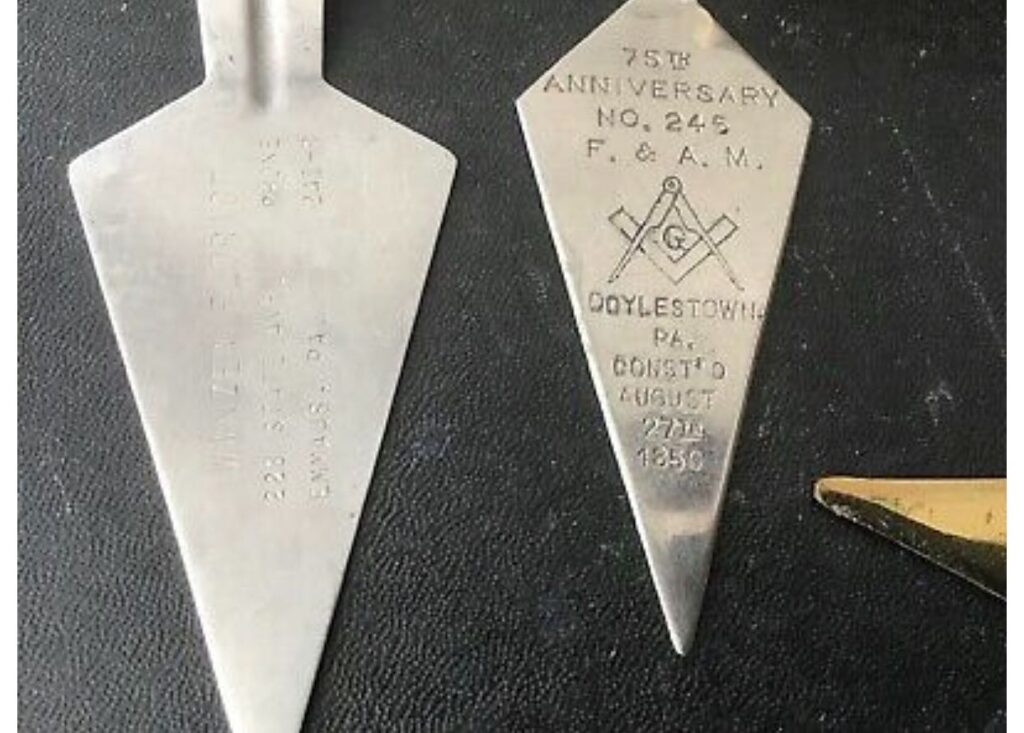
The lodge was constituted back in 1850, although the current building wasn’t in use until 1859. The next anniversary (175th) will be in 2025 where the anniversary set will include 10 years of master medals.
169th Annual Banquet
The 169th Anniversary Annual Banquet will be held on Wednesday, October 23, 2019 at The Bucks Club in Jamison, PA.
Social Hour – Hors D’oeuvres – Cash Bar
6:00 pm – 7:00 pm
Dinner Buffet and Program
7:00 pm – 10:00 pm
Summer Projects
Thank you to the Building Committee and assisting Brethren for their hard work installing the new fence and benches at the front entrance.
2nd Annual Grand Master’s Eastern Sporting Clay Event
Schedule:
8:30 a.m. Registration and warm up
10 a.m. Shooting will begin promptly
Cost: $150 per person, breakfast & lunch included / $25 non-shooter lunch
Winners will be determined by the Lewis Class system. Chinese Auction, 50/50 and more! Registration deadline is August 30, 2019. For more information, call Jeff at 724-396-8001.
Shooters must provide their own ammunition. All proceeds benefit the Masonic Temple/Masonic Library and Museum of Pennsylvania. Sponsorships are tax deductible.
Tall Cedars of Lebanon
The Tall Cedars of Lebanon of North America is a side degree of Freemasonry, open to Master Masons in good standing in a regular Masonic Lodge. Its motto, “Fun, Frolic, & Fellowship,” is indicative of this social bent. Its members are distinguished by the pyramid-shaped hats they wear at their functions. The name is derived from the cedars of Lebanon that King Solomon used to build his Temple.
Read more“Tall Cedars of Lebanon”
The Masonic Family: THE ROYAL ORDER OF SCOTLAND
With their own terminology, structures and practices, each masonic Order is different from the next. Freemasonry Today breaks down the origins, requirements and organization of the Royal Order of Scotland. One of the most historic Orders in Freemasonry, The Royal Order of Scotland’s ritual traditions reach back 700 years to Robert the Bruce.
The Masonic Family: Royal and Select Masters
With their own distinctive terminology, structures and practices, each Masonic Order is different from the others. The Grand Lodge of England breaks down the UK origins, requirements, and organization of Royal and Select Masters.
Valley Forge’s Washington Monument
The National Memorial Arch was originally one of two commemorative arches planned: one for General George Washington and the second, slated for construction elsewhere on the grounds, for General Von Steuben. These were to serve as actual entry and exit gates, allowing access to and from the park, whose perimeter in those days was defined by iron fencing.